Online Readiness Course
Course Objectives:
Module Objectives:
What is the Quality Matters Program?
Quality Matters (QM) is a faculty-centered, peer review process that is designed to certify the quality of online and blended courses. QM is a leader in quality assurance for online education and has received national recognition for its peer-based approach and continuous improvement in online education and student learning. QM subscribers include community and technical colleges, colleges and universities, K-12 schools and systems, and other academic institutions.
There are three primary components in the Quality Matters Program:
The QM Rubric, the Peer Review Process, and QM Professional Development
The rapid growth of online education has forced institutions, faculty, and students to quickly adopt and adapt to this new mode of education. Given its recent evolution, there are people who continue to question the quality of education achieved through the online format.
In an effort to address the concerns about quality online education, the U.S. Department of Education's Fund for the Improvement of Post-Secondary Education (FIPSE) awarded a three year grant in 2003 to Maryland Online, Inc., Maryland's higher education distance learning consortium, as a means to begin to address the issue of online course quality assurance. The Rubric and materials you are using in this course evolved from that grant, originally titled Quality Matters: Inter-Institutional Quality Assurance in Online Learning.
In 2007, Quality Matters became a not-for-profit entity under Maryland Online in order to continue the good work accomplished during the grant funding period. QM has updated the Rubric two times since the grant funding period ended and has grown into a subscription-based service with subscribers across the United States and in some foreign countries.
Over time, Quality Matters has become a self-supporting, non-profit organization and uses the following underlying principles to guide its work:
Continuous
Centered
Collegial
Collaborative
The review team consists of three experienced online instructors as reviewers along with the course faculty developer.
Integral to the QM process is the belief that there are many factors that affect the quality of an online course. These include:
|
Course Design |
Course Delivery |
Course Content |
|
Learning Management System |
Institutional Infrastructure |
Faculty and Student Readiness |
The Charts Activity below contains an "Online Course Quality " pie chart. Move your mouse over each portion of the pie to see a description of each factor.
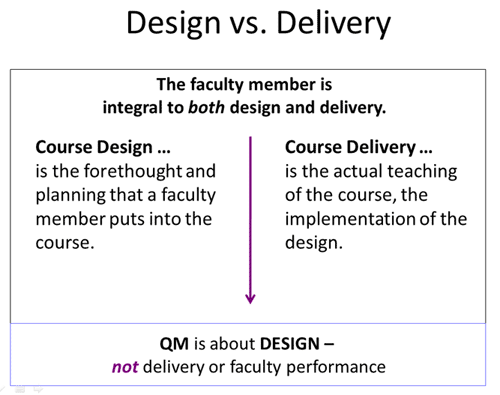
One of the key QM concepts is the distinction between course design and course delivery. QM recognizes that this is a fine line, but course design is the primary emphasis during a review. Below are the definitions to help you understand this distinction:
Practice the difference between 'design' and 'delivery' in the Sorting Activity below (click "Sorting Activity" to get started).

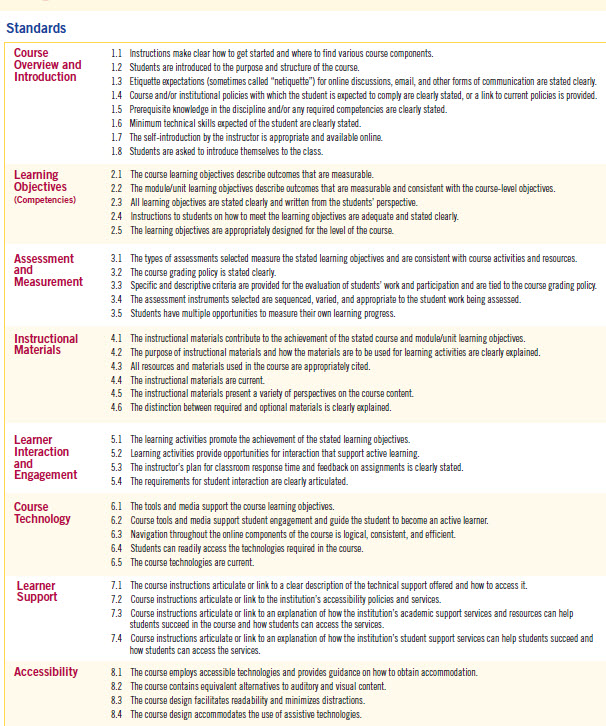
The Quality Matters Rubric consists of 41 standards assigned different points depending on their relative importance. Twenty-one (21) of the standards are considered essential in a quality online course and have the highest point value of 3. The remaining 20 standards are assigned 1 or 2 points. The maximum possible number of points in 95.
|
STANDARDS |
POINTS |
RELATIVE VALUE |
|
21 |
3 |
Essential |
|
12 |
2 |
Very Important |
|
8 |
1 |
Important |
|
41 |
95 |
|
|
Answered 'Yes' to all 3-point Essential Standards AND A total overall score of 81 out of 95 points. |
|
Standard Description |
Examples |
Points |
|
1.1 Instructions make clear how to get started and where to find various course components. |
Examples Standard 1.1 |
3 |
|
1.2 Students are introduced to the purpose and structure of the course. |
Examples Standard 1.2 |
3 |
|
1.3 Etiquette expectations (sometimes called "netiquette") for online discussions, email, and other forms of communication are stated clearly. |
Examples Standard 1.3 |
2 |
|
1.4 Course and/or institutional policies with which the student is expected to comply are clearly stated, or a link to current policies is provided. |
Examples Standard 1.4 |
2 |
|
1.5 Prerequisite knowledge in the discipline and/or any required competencies are clearly stated. |
Examples Standard 1.5 |
1 |
|
1.6 Minimum technical skills expected of the student are clearly stated. |
Examples Standard 1.6 |
1 |
|
1.7 The self-introduction by the instructor is appropriate and is available online. |
Examples Standard 1.7 |
1 |
|
1.8 Students are asked to introduce themselves to the class. |
Examples Standard 1.8 |
1 |
|
Standard Description |
Examples |
Points |
|
2.1 The course learning objectives describe outcomes that are measurable. |
Examples Standard 2.1 |
3 |
|
2.2 The module/unit learning objectives describe outcomes that are mesurable and consistent with the course-level objectives. |
Examples Standard 2.2 |
3 |
|
2.3 All learning objectives are stated clearly and written from the student's perspective. |
Examples Standard 2.3 |
3 |
|
2.4 Instructions to students on how to meet the learning objectives are adequate and stated clearly. |
Examples Standard 2.4 |
3 |
|
2.5 The learning objectives are appropriately designed for the level of the course. |
Examples Standard 2.5 |
3 |
|
Standard Description |
Examples |
Points |
|
3.1 The types of assessments selected measure the stated learning objectives and are consistent with course activities and resources. |
Examples Standard 3.1 |
3 |
|
3.2 The course grading policy is stated clearly. |
Examples Standard 3.2 |
3 |
|
3.3 Specific and descriptive criteria are provided for the evaluation of students' work and participation and are tied to the course grading policy. |
Examples Standard 3.3 |
3 |
|
3.4 The assessment instruments selected are sequenced, varied, and appropriate to the student work being assessed. |
Examples Standard 3.4 |
2 |
|
3.5 Students have multiple opportunities to measure their own learning progress. |
Examples Standard 3.5 |
2 |
|
Standard Description |
Examples |
Points |
|
4.1 The instructional materials contribute to the achievement of the stated course and module/unit learning objectives. |
Examples Standard 4.1 |
3 |
|
4.2 The purpose of instructional materials and how the materials are to be used for learning activities are clearly explained. |
Examples Standard 4.2 |
3 |
|
4.3 All resources and materials used in the course are appropriately cited. |
Examples Standard 4.3 |
2 |
|
4.4 The instructional materials are current. |
Examples Standard 4.4 |
2 |
|
4.5 The instructional materials present a variety of perspectives on the course content. |
Examples Standard 4.5 |
1 |
|
4.6 The distinction between required and optional materials is clearly explained. |
Examples Standard 4.6 |
1 |
|
Standard Description |
Examples |
Points |
|
5.1The learning activities promote the achievement of the stated learning objectives. |
Examples Standard 5.1 |
3 |
|
5.2 Learning activities provide opportunities for interaction that support active learning. |
Examples Standard 5.2 |
3 |
|
5.3 The instructor's plan for classroom response time and feedback on assignments is clearly stated. |
Examples Standard 5.3 |
3 |
|
5.4 the requirements for student interaction are clearly articulated. |
Examples Standard 5.4 |
2 |
|
Standard Description |
Examples |
Points |
|
6.1 The tools and media support the course learning objectives. |
Examples Standard 6.1 |
3 |
|
6.2 Course tools and media support student engagement and guide the student to become an active learner. |
Examples Standard 6.2 |
3 |
|
6.3 Navigation throughout the online components of the ourse is logical, consistent, and efficient. |
Examples Standard 6.3 |
2 |
|
6.4 Students can readily access the technologies required in the course. |
Examples Standard 6.4
|
2 |
|
6.5 The course technologies are current. |
Examples Standard 6.5 |
1 |
|
Standard Description |
Examples |
Points |
|
7.1 The course instructions articulate or link to a clear description of the technical support offered and how to access it. |
Examples Standard 7.1 |
3 |
|
7.2 Course instructions articulate or link to the institution's accessibility policies and services. |
Examples Standard 7.2 |
3 |
|
7.3 Course instructions articulate or link to an explanation of how the institution's academic support services and resources can help students succeed in the course and how students can access the services. |
Examples Standard 7.3 |
2 |
|
7.4 Course instructions articulate or link to an explanation of how the institution's student support services can help students succeed and how students can access the services. |
Examples Standard 7.4 |
1 |
|
Standard Description |
Examples |
Points |
|
8.1 The course employs accessible technologies and provides guidance e on how to obtain accommodation. |
Examples Standard 8.1 |
3 |
|
8.2 The course contains equivalent alternatives to auditory and visual content. |
Examples Standard 8.2 |
2 |
|
8.3 The course design facilitates readability and minimizes distractions. |
Examples Standard 8.3 |
2 |
|
8.4 The course design accommodates the use of assistiez technologies. |
Examples Standard 8.4 |
2 |
Test your knowledge on the Quality Matters Standards. To complete this activity, you may want to have a copy of the rubric to use as a guide.
The following document will be very helpful as you complete the Self-Check questions. You may either have the document open and switch back between the document and Module 2. Or, you can simply print out the Word document to have it handy when answering the questions.
 You have successfully completed the Module 2 Quality Matters lesson module.
Apply the knowledge learned in the lesson module by completing the activities, assignments, discussions, reflections, and/or feedback evaluations located in the Moodle course.